
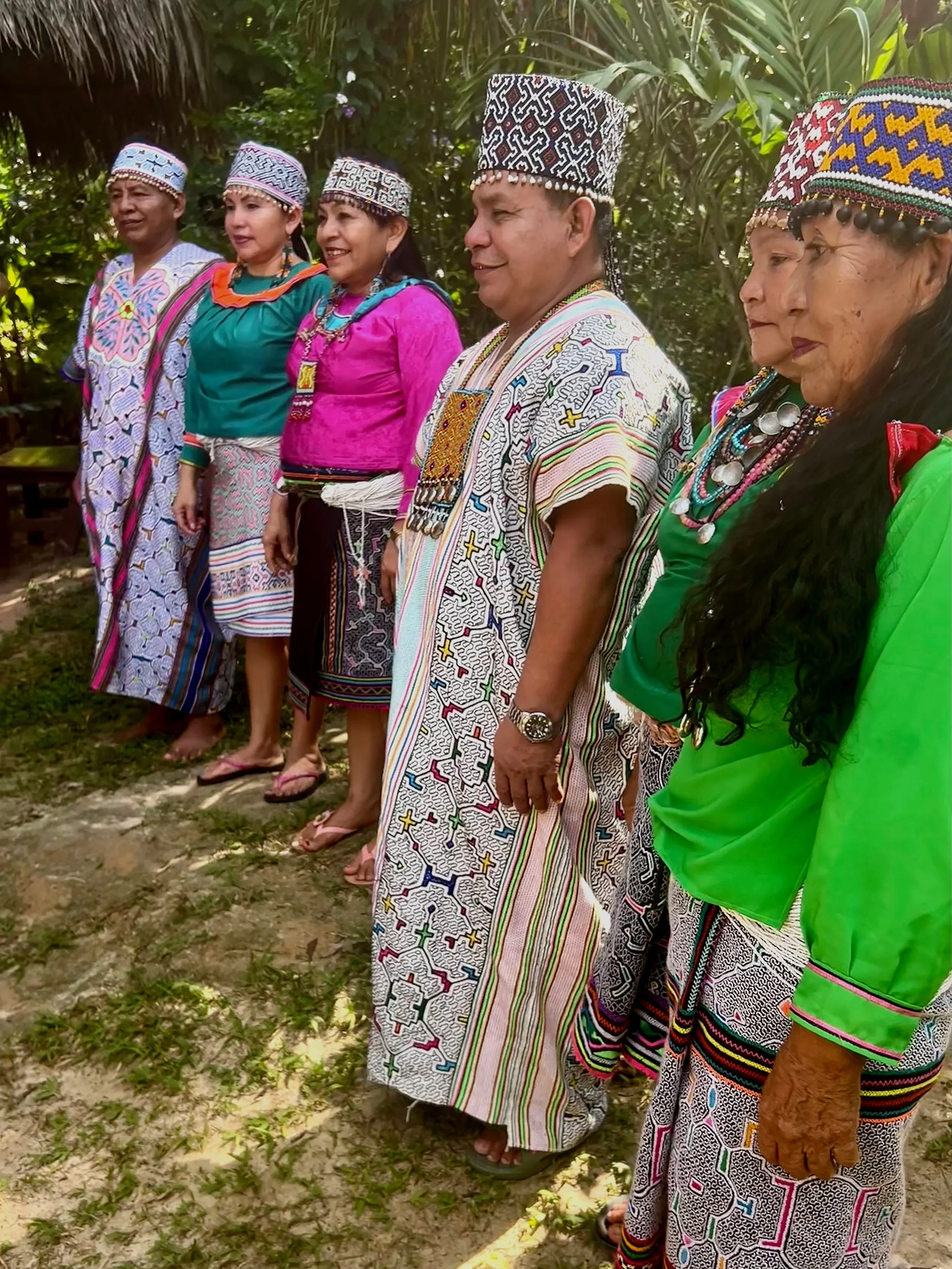
TRAUMA SENSITIVE, BODY-LED PSYCHEDELIC COACHING
PREPARE FOR AND INTEGRATE A PSYCHEDELIC EXPERIENCE WITH THE SUPPORT OF A PSYCHEDELIC RETREAT FACILITATOR
With all advances in understanding the potential of psychedelics to treat alarming levels of mental ill health, access is just a part of the picture.
Though psychedelic plant medicines like psilocybin and ayahuasca can release huge amounts of stored tension and effect profound shifts in perspective within just a few hours, they aren’t magic elixirs in and of themselves. They aren’t the destination. I think of them as opening a door, a clearing in the tightly knitted, dark forest of our programming, and pointing to pathways out through it all with more clarity.
It’s a neuroplastic loosening in the brain, in a sense - a window of opportunity of a few weeks to a few months - and it’s up to each individual to choose to harness this period of potential by walking through the door and following what is pointed towards, releasing old mind-stories and embedding tender new perspectives and more conscious behavioural patterns.
The work invites taking responsibility for changing habits, building in self-supportive routines and self-reflection. All of which requires support from the moment the idea to engage with psychedelic work arises until long after the experience.
In 2025 an international consensus of researchers, spanning almost 90 experts across 17 countries and published in Nature Medicine (link to paper), confirmed that the context surrounding the ingestion of psychedelics to heal mental illness has as much bearing on their impact as the molecules themselves. It highlighted not just the quality of the therapeutic/facilitator relationship, but the preparation beforehand and integration afterwards.
Preparation COACHING
1) WHAT IS INVOLVED?
Good psychedelic preparation happens across multiple sessions, not in a single call. Clinical protocols such as those used at Johns Hopkins involve three to five preparation sessions over several weeks, each typically 60 to 90 minutes long [8]. A well-run retreat compresses this into one or two video sessions before arrival plus on-site preparation in the day or two before the dosing session. Good preparation uses that time to build trust, clarify your intentions, explain what the substance is likely to feel like, and teach anchoring techniques for difficult moments.
2) HOW I APPROACH PREPARATION
My approach doesn’t just involve talking. It is my strong encouragement to introduce some form of contemplative practice to your day-to-day routine, if you do not already have one, in order to develop your capacity for embodied presence. In other words, to learn to, or develop the habit of, coming to stillness within your busy days, stepping back from ‘doing’ and practicing noticing what is present, including sensations in your body, feelings or patterns of thought.
1) WHY IS PREPARATION IMPORTANT?
A capacity to ‘be with what is arising’ without judgment of ourselves or pushing it away because we need to be doing other things is a hugely valuable toolkit for a number of reasons.
In the lead up to a retreat, it can start to show you what may be present within your body-mind that is asking for clarity, release or a resolution of some kind through your work with the plants, and therefore may help shape your intention/s for your medicine ‘ceremonies’.
It can also help to strengthen your capacity to be present during ceremony, when the medicine is active, and observe what is being communicated to you.
Moreover, if ever things become a bit challenging, breath and mindfulness tools can help you manage your nervous system’s response in order to to stay with difficult emotions, equipping you to be steady and grounded whatever may be unfolding.

“Body treatment is somewhere, like, way on the periphery of the world. Instead, we sit in a chair and we talk to people, somehow trying to magically make people safe in their body.
I did the first National Institutes of Health-funded study on Yoga. It is more effective for chronic PTSD than any drug with people I've ever studied. If you learn how to really inhabit your body and learn to feel comfortable moving your body and being in your body, something starts shifting.”
Dr Bessel van der Kolk, psychiatrist, author and trauma researcher.
Why Work With Me?
You don’t need to explain yourself to me.
I understand how hard it can feel to reach out — especially when you’re used to handling things on your own. I’ve worked with veterans and their families who were skeptical at first, but discovered that this work gave them deeper insight into the underlying mechanisms at work, as well as addressing symptoms with practical tools.
Here’s why people choose to work with me:
I get the military world. I grew up in a family of people serving in the British Army and Royal Air Force, living from one posting to the next, and seeing active service during war. I also witnessed their transition to being veterans. So I understand the culture and the challenges — for you and those close to you.
You don’t need to talk about your experiences. This approach is body-based and doesn’t require you to relive or explain what happened.
It’s structured and practical. I know how important clarity and discipline are — I’ll give you a clear, tailored plan that fits your needs.
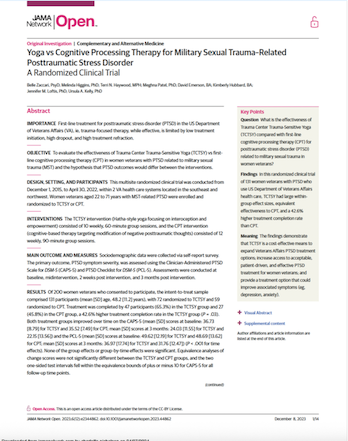
It actually works. The methods I use, including Trauma Center, Trauma Sensitive Yoga (TCTSY), have been clinically proven to help reduce symptoms of PTSD and improve quality of life, including for veterans specifically.
You’re in charge. I’ll guide you, but you decide what feels right for you each step of the way. You’ve already proven you can handle hard things. This isn’t about adding to your burden — it’s about giving you a practical way forward.
HOW WE CAN WORK TOGETHER
If you are a serving or formerly serving member of the armed forces, or you are a loved one of a current or former military service person, and you are struggling with the impacts of PTSD or complex trauma, I would recommend exploring Trauma Center, Trauma Sensitive Yoga (TCTSY) with me in the first instance. TCTSY is an empirically validated therapeutic intervention for these conditions, both of which profoundly change our relationship with our body.
Developed at Center for Trauma & Embodiment in Massachusetts, USA, it is supported by more than 10 original peer reviewed studies, numerous led by Dr Bessel van der Kolk, international trauma expert and author of The Body Keeps the Score (see my Resources page), and his research team, and many more independent analyses. You can read more about TCTSY here.
It can be done one-to-one in private sessions, or in small group sessions, for example for a charity or other service provider. They can be attended either in person (if it makes sense geographically) or online via Zoom. Below I outline the steps involved in this option.
You are welcome to book a free initial call with me to explore other options, too.
We start with a conversation.
We begin with a conversation about what’s going on for you, what you’re struggling with, and what you want to achieve, and I will tell you more about TCTSY and a session is like practically. This initial call is free and you are under no obligation to subsequently work with me.
2. INTAKE QUESTIONNAIRE.
If we decide it’s a good fit to work together, I will send you my TCTSY intake questionnaire. It asks a series of questions, the answers to which help me understand how best to work with and support you. The more information I have the better, however, you are also free to choose not to answer a question/s.
3. WE PLAN A FIRST SESSION.
The sessions are usually up to an hour long and we decide whether to do them in person or online. You can then decide if you want to book further sessions with me.
4. We work together at your pace.
You can book further sessions with me as you go, according to your needs, or you can book a block of sessions. I will do my best to fit these in with your schedule.

Ready to Take the First Step?
If what you’ve read resonates, let’s have a conversation. No commitment, no pressure — just a chance to talk through where you are, what you need, and whether this approach is right for you.
Is This Right for Me?
-
Trauma - and PTSD in particular - is characterised by an inability to be present with and tolerate intense emotions and sensations playing out in the body whenever old emotional wounds are triggered. Because these sensations are similar to the terror of the original wounding experience, the nervous system reacts as though it is happening all over again and goes into emergency mode, releasing torrents of stress hormones preparing us to escape or defend ourselves, or the response may be to freeze or shut down ‘until it’s over.’ A body in these conditions is very difficult to be in, which is why so many people will reach for something to numb or distract them, whether substances or other kinds of self-harm, mindless scrolling or a response like workaholism.
Anything but be present.
Yoga is a practice that, on the other hand, develops the capacity to be with uncomfortable or challenging sensations and use body tools like the breath to support staying present and tone down the nervous system’s reaction.
Trauma sensitive yoga is not just about stretching or fancy poses. It’s about helping our nervous system reset so we can feel more calm and in control. The movements are simple and accessible to everyone.
-
Exercise is so important for fitness and therefore overall wellbeing, but it involves stimulating our nervous system, which is why we get hot and sweaty and our heart and breathing rates soar.
In people who have endured traumatising experiences, and who may be experiencing the symptoms of PTSD, their nervous system is already over-stimulated - chronically over-stimulated, since it is hyper-alert and constantly perceiving threats.
As a counterbalance, it is important to develop the capacity to down-regulate our nervous system - to learn tools that enable us to tell our brain that we are no longer in the past and in danger, but present in the now and safe. These tools can slow our heart and breathing rates and induce a more restful state of being. Being able to induce this ‘relaxation response’ is vital for switching back on functions like digestion, sleep/rest, cellular repairs of damaged tissues and capacities for social communication and bonding - all the things that get dialled down when our nervous system is stressed, but that are vital to thriving.
Mindful embodied practice like yoga supports this.
-
No. This work is entirely body-based. You never have to say anything you don’t want to. As your guide I will talk to offer shapes for you to explore and alternative ways of approaching or adjusting them, but otherwise there need not be any further talking. The offering with this practice is to be curious about what you are noticing in your body in the present, just as I will be as I’m practicing along with you about what is happening in my body. The aim, bit by bit, is to teach your nervous system that you are no longer in the past in whatever situation/s hurt you, by re-connecting it to the now and letting it know that you are safe. This requires no words, only shapes, movements and taking back agency to make choices about how you explore them.
-
Definitely. In fact, being stiff is probably a better starting point than being too flexible, since we need stability in the system to protect our joints if we stumble or fall. I think and work in terms of healthy range of motion to support daily activities, rather than extreme stretching. Your practice would be developed in close collaboration with you, exploring how each shape and technique feels for your body-mind, and making bespoke adjustments as necessary. In addition, the beauty of having the same practice that is repeated day after day means you have a clear yardstick for observing incremental changes in the range of motion within your body.This is about building awareness and safety, not touching your toes.
-
That’s understandable. This approach equips you with tools that can help you feel more able to handle what comes up without being overwhelmed. These tools - body, breath and mindfulness tools that you carry around inside you all the time - can help to increase something called your ‘window of tolerance’ for stress in neuroscience. In other words, they help you to better regulate your nervous system, so that even when something triggers you, you are able to manage your heart and breathing rates and allow intense emotions - which are really nervous energy in motion - to move through you and discharge after a few minutes, rather than feeling helpless or knee-jerk reacting in a way that you later regret. You could say that this practice and process is about learning to better feel, rather than just feel better.
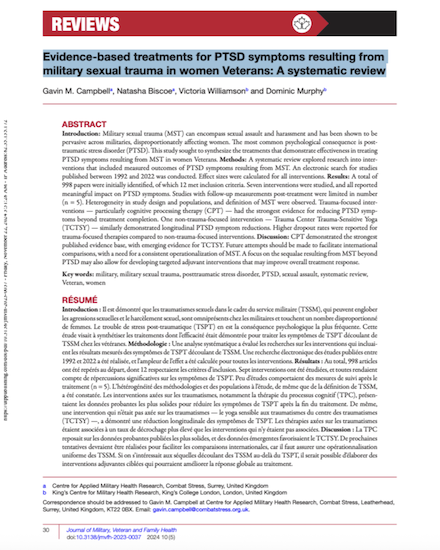
VETERANS, PTSD & TRAUMA-INFORMED EMBODIED PRACTICE: ACADEMIC PAPERS
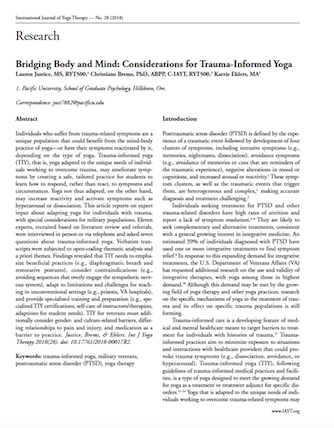
Bringing the body into treatment for healing trauma-related symptoms is now backed by science and years of research. Feel free to visit my Resources page for further academic papers, book recommendations and blog articles too, if you’d like to dig deeper.
bessel van der kolK
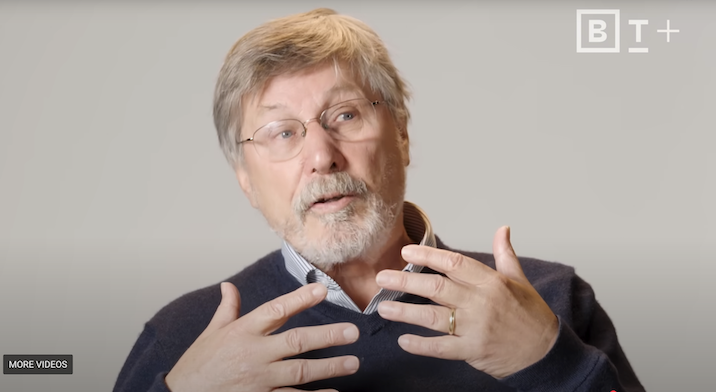
The psychiatrist, neuroscientist, co-creator of Trauma Sensitive Yoga (TSY) and leader of the world’s first randomised clinical trial assessing the potential of TSY to support recovery discusses his early professional experiences with veterans and the observations that led to his paradigm-shifting work on PTSD.
What is the financial investment?
1-1 sessions for individuals:
Initial ‘hello’ chat - free
£80- £120 per session, for those in employment, dependent on session length, from 30 mins.
The first paid session would be an intake / assessment call, including review together of a detailed intake questionnaire and planning the schedule of next sessions.
£60 - £80 per session, for people in receipt of benefits/social support or otherwise on reduced incomes, dependent on session length, from 30 mins.
Again, the first paid session would be an intake / assessment call, including review together of a detailed intake questionnaire and planning the schedule of next sessions.
If you would like to organise group sessions, feel free to get in touch with me to explore.
Small group sessions (for example, organised through charities):
Initial ‘hello’ chat - free
£20 per person per session, minimum group size of 4 people.
Let’s Talk
It can be intimidating to take this first step, I’m grateful you’re here and I hope to work with you.
If you would like to book a free consultation call, please fill in the form below and I will be in touch with you.