
What Ayahuasca and Shipibo Healing Have Taught Me About the Nature of Healing
What Ayahuasca and Shipibo Healing Have Taught Me About the Nature of Healing
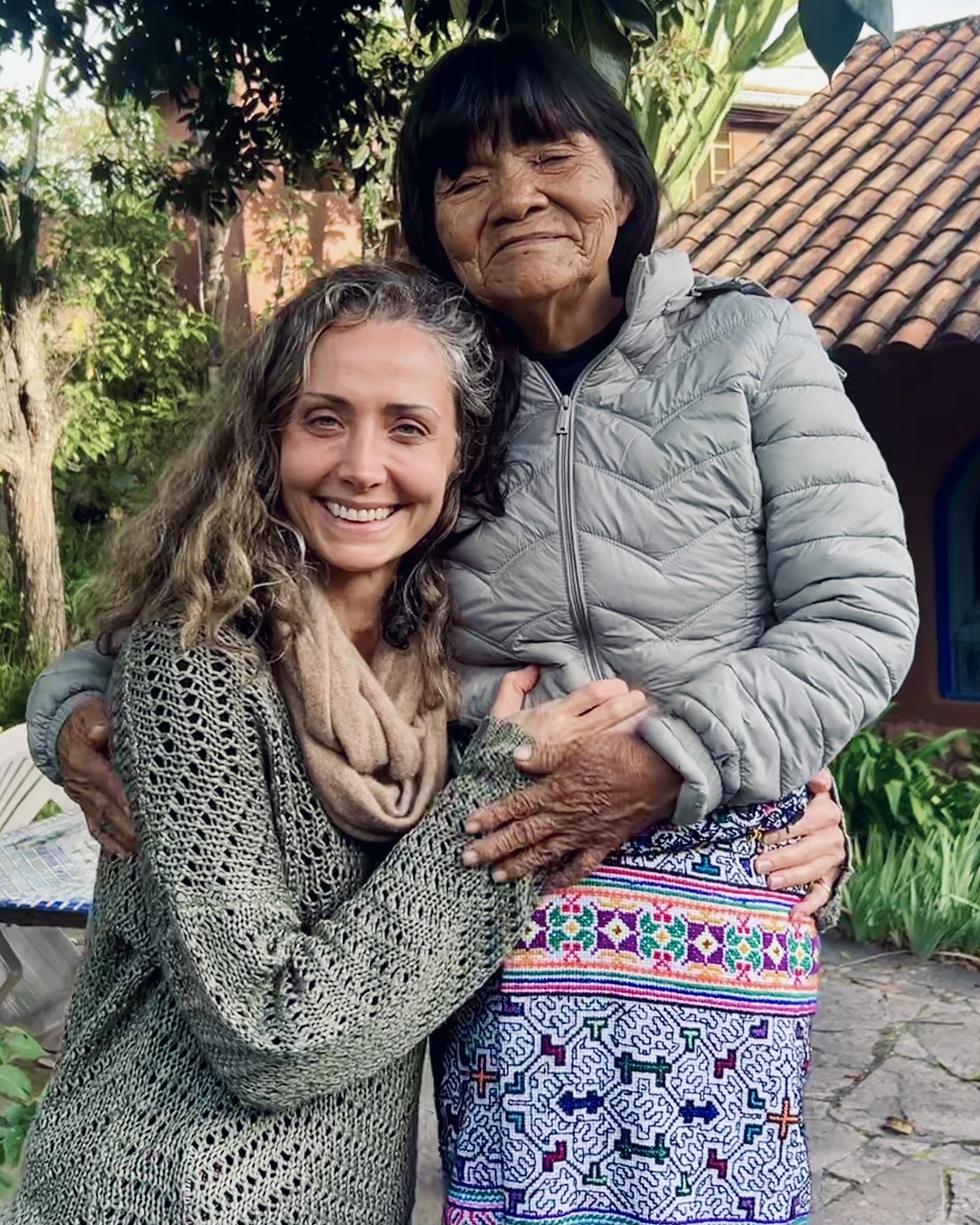
Reflections on witnessing Wordless Repair
Long before I began facilitating legal psychedelic retreats, I found myself sitting quietly at the edge of a maloca in the Peruvian Amazon and Andes, observing something that would gradually change the way I understood healing.
Not because of the medicine itself.
But because of the people who had worked with it for generations.
One of those people is Maestra Juana, a Shipibo curandera, mother of eight and grandmother many times over. She comes from a long lineage of traditional plant healers whose knowledge has been passed from one generation to the next through direct experience rather than textbooks or laboratories.
Like many indigenous healers, she doesn’t describe her work in the language of neuroscience, psychology or medicine.
She doesn’t speak about trauma responses, nervous systems or neuroplasticity.
Instead, she sings.
She listens.
She observes.
She enters into relationship with the person sitting before her in ways that are difficult to describe using Western concepts alone.
Spending time alongside her has taught me many things.
Not only about ayahuasca.
But about healing itself.
Healing speaks more than one language
One of the greatest differences I noticed between the Shipibo tradition and the Western therapeutic models I had trained in was the role of language.
Much of Western therapy quite understandably begins with conversation.
We tell our stories.
We explore memories.
We make meaning.
Words can be profoundly healing. But sitting in ceremony, I realised there were moments when words seemed to become secondary.
Healing appeared to unfold through relationship.
Through attention.
Through song.
Through the body.
Through silence.
Watching Maestra Juana work, I was struck not by how much she explained, but by how little she needed to.
Whether we understand what happens in ceremony through the lens of indigenous cosmology, contemporary neuroscience, psychology or some combination of the three, I came away with a deep respect for the idea that words are only one language through which human beings heal.
Witnessing wordless repair
People often ask me what happens during an ayahuasca ceremony. The honest answer is that much of it resists easy explanation. People use the word ‘ineffable’ a lot in this field, and for good reason.
I’ve watched people laugh.
Cry.
Shake.
Yawn.
Sweat.
Vomit.
Become profoundly still.
I’ve seen people sit quietly for hours before describing a feeling of lightness they hadn’t experienced for years.
The Shipibo tradition understands many of these experiences through its own sophisticated framework of energetic healing, developed and refined over centuries.
Western science offers different perspectives, exploring the roles of trauma, memory, emotion, physiology and altered states of consciousness.
I don’t see these as competing explanations. Rather, I see them as different languages attempting to describe aspects of the same deeply human experiences.
What seems undeniable to me is this: Our body is not simply accompanying the healing process. It is leading it.
Our body already knows what to do with these substances once we ingest them. That’s what I tell my clients and retreat guests. Your body already knows what to do. Some of what it wants to do may feel unfamiliar or strange, but can you nevertheless step aside - set your mind to one side - and allow it?
There’s nothing else you need to do or say, once you’re in the experience.
The body often knows before the mind does
Having said ‘try to allow your body to do what it needs to do’, it’s not something that comes easily or naturally to many of us, so the capacity - to trust as much as anything - has to be developed.
The capacity to remain present even when there’s something difficult unfolding there.
To stay connected with ourselves - noticing, being curious, compassionate.
To notice fear without becoming overwhelmed by it.
To experience emotion without immediately needing to escape it or brace for impact.
Working in trauma-informed practice has only deepened this understanding. Trauma is not simply something we remember; it is something our bodies adapt to. Usually over lengths of time. Re-adapting also takes time, patience, support.
This is one of the reasons body-led approaches are such an important part of psychedelic preparation and integration.
Not because they provide answers.
But because they help people develop enough trust to meet whatever arises. They’ve been my own most powerful tookit.
Preparation and integration are part of the medicine
Perhaps the biggest shift in my own thinking has been this: I no longer think of preparation and integration as something that happens either side of a psychedelic experience.
I think they are part of the process itself.
Preparation isn’t simply about understanding what might happen during ceremony. It’s about cultivating enough internal and external stability that whatever unfolds can - to reiterate - be met with greater curiosity than fear.
Integration is not simply talking about what happened afterwards. It’s asking how those experiences might, bit by bit, shift the dial on the way we are living.
How we relate.
How we care for ourselves.
How we set boundaries.
How we return to our ordinary lives with extraordinary insights translated into small, sustainable changes.
Because in my experience, that is where lasting transformation happens.
Healing isn’t something done to us
One of the reasons I continue to feel such respect for the Shipibo - who have described themselves to me more as vessels for something to move through them rather than the direct agents of healing - is that, despite our very different cultural frameworks, it has reinforced something I now see reflected across many forms of healing.
Whether we’re talking about psychotherapy, trauma-sensitive body-led work, meditation, meaningful relationships or psychedelic-assisted therapy, healing rarely seems to arrive because another person ‘fixes’ us.
Rather, it emerges when the conditions are right.
When we feel sufficiently supported.
Sufficiently resourced.
Sufficiently safe to allow something within us to move that has perhaps remained frozen for years.
The longer I spend working alongside both indigenous healers and Western therapeutic approaches, the less interested I become in deciding which one is “right.”
Instead, I ask more and more:
What helps people remember the innate movement towards healing that already exists within them?
People heal. Sometimes psychedelics create the conditions.
Over recent years, the scientific understanding of psychedelics has developed enormously. Research continues to explore neuroplasticity, changes in large-scale brain networks, emotional processing and psychological flexibility.
Further findings are coming think and fast and academic thinking is rapidly evolving.
Through it all, however, I’ve arrived at this:
Psychedelics don’t heal people.
People heal.
Sometimes psychedelic experiences create conditions that make that healing more possible.
They may soften rigid patterns of thinking, create opportunities for emotional processing and invite new perspectives, opening doors that previously felt firmly closed.
But walking through those doors - and learning to live differently afterwards - remains very much human work, very much our work, each individually, and supported by the collective.
It sometimes loops and spirals rather than progressing in a linear fashion, it’s often messy, but its ours.
Carrying these lessons forward
Perhaps one of the greatest gift ayahuasca has given me has been humility.
Humility about how much we still don’t know.
Humility about the extraordinary wisdom safeguarded within indigenous traditions; wisdom that can steer us back to our own indigenous roots and ways of being, if we let it.
And humility about the remarkable capacity human beings have to heal themselves when the conditions are right for it to emerge.
Further reading: RESEARCH INTO THE EFFICACY OF TRAUMA SENSITIVE YOGA
